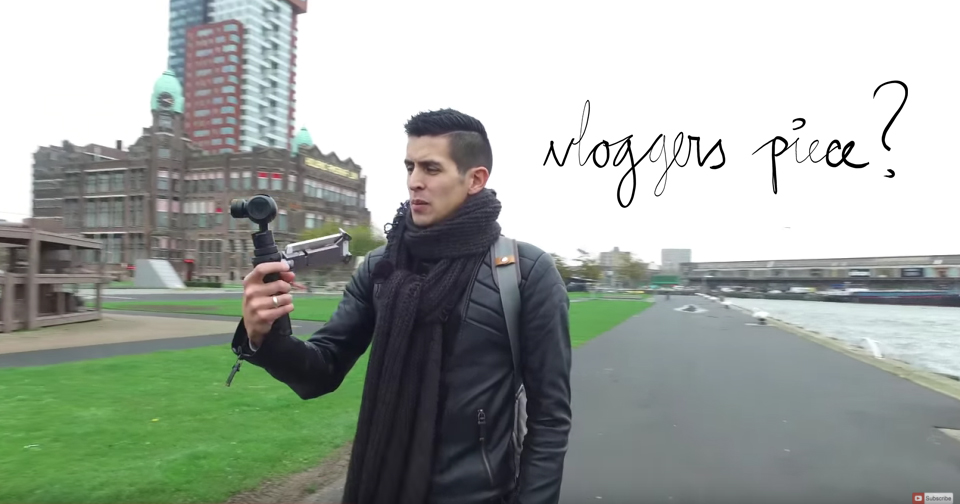
Nowadays almost everyone who´s active on the web is a vlogger …I mean, I think there are more vloggers than bloggers out there right? Now there is an amazing camera for vloggers, one that’s small yet provides the best quality possible: DJI Osmo.
I had the pleasure of reviewing the DJI Osmo …a handheld stabilised video/photo camera. In short, it’s a great camera for people who like to take video while moving to create nice angle shots and a more cinema-look video.
The nice thing of this camera are the controls, they make it possible to capture what´s happening all around you by easily moving the camera around with the joystick on the back. Taking pictures instantly is also possible with a click of the button and for a selfie moment you click twice and the camera will turn towards you so you´ll be in the picture yourself.
The Osmo has to connect with your smartphone so you can adjust the settings of the camera and also control it by touching the screen. This is a great camera and to be honest maybe a bit to good for vlogging alone. One downer is the battery which won´t last long and also the connection with your phone really drains your phone battery. Also the microphone is quite bad ..an external microphone is a must.
For the Dutchies out there, down below is the video review of the DJI Osmo which I did for Kamera Express.
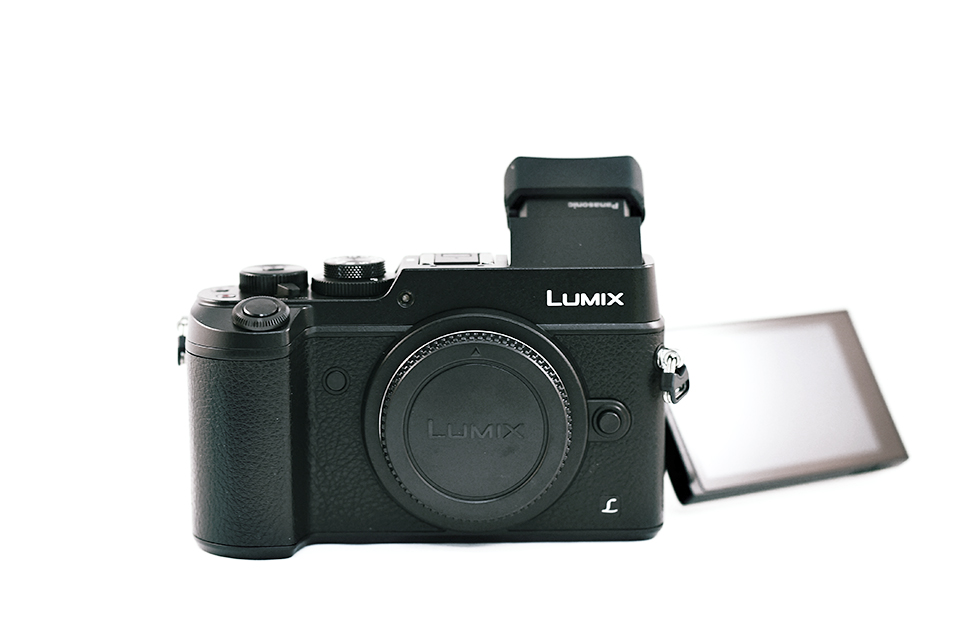
I had the pleasure of reviewing the Lumix GX8, the successor of the GX7. I must say it’s quite a camera and I will tell you why.
(review video for Kamera Express, Dutch only)
Improvements
Firstly the key improvements are the new 20 MPX sensor, Venus Engine Image processor, 4K video and faster AF-system. For me the most important improvements are the faster AF in both video and stills, the faster burst of 10 pics per second and the larger body/ grip.
Not only is this camera specs-wise better than the GX7, the whole handeling is better. Buttons are more logically placed and the camera reacts faster, which is essential on the streets.
Option overload?
One downside of this camera, after only using it for this review, are the extensive options. I’m quite basic when using a camera, so I immediately noticed lots if options I normally don’t need. So there were moments I had to search for a specifik setting. This is a personal thing maybe, these extensive options quite be practical for another person.
In short
This camera has quite a large sensor so expect to see good quality photos, nice shallow depth and good low light performance. A small body(compared to reflex bodies) and especially awesome small build lenses with great performance. Luckily the GX8 has still kind of the same body as the GX7, so perfect for street photography thanks to its retro rangefinder look.
Here’s a small share about the legendary, Canon 85mm f1.2 L II lens. I decided to mount it on my DSLR for a few minutes and it was a nice experience. The barrel alone is quite a thing ….it is bulky but that’s because of all the glass elements within it.
In short …
I only got it mounted for a few minutes so there’s no deep review here. What I can say is that the lens performs good, but not good enough looking at the price tag. The photos show a lot of color fringing, nevertheless it does a good job at minimizing the vignetting at f1.2. The lens itself it heavy of course, but the worst thing is the slow focus. If I had owned this lens it would probably fill a empty space on my shelf because on the streets I need fast focus and less weight. But hey …it would be a pretty thing standing on my shelf 😉
Before I get into this nice piece of glas, let’s answer some of the common general questions I get: Why Sigma? Aren’t they just a cheaper imitation of the Canon lenses?
I get why people sometime ask me these questions, because yes Sigma used to produce cheaper versions of Canon lenses (also other brands). So several years ago one bought a Sigma lens to get a more affordable lens with almost the same quality. But that’s in the past now! Sigma launched their ‘Art’ series lenses, which aren’t only better in performance but some are even more expensive than the Canon lenses. Now when you decide to purchase an Art lens of Sigma you want to get the best in performance and build quality.
shot at f1.4 (bit color fringing)
nice bokeh at f1.4
Sigma 50mm f1.4 Art
One of the most spoken Art lens is the 50mm f1.4, which seems to be even better than both the 50mm f1.4 and f1.2 of Canon. That’s why I decided to test this nice piece of glass.
This new lens is perfect for portrait and wedding photography. It’s great to see Sigma making such professional lenses. Thanks to the f1.4 the depth of fields is shallow and good for isolating the subject.
Build
The 50mm lens is well designed and solidly build, as expected of an Art lens. I like the simplicity of its design and the large focus ring. There’s only a MF/AF switch on the barrel and of course the nice shiny ‘A’ logo. The weight and size of this lens is too much for me …walking the streets with this lens would be quite uncomfortable with a tired wrist at the end of the day. When comparing this lens to my Canon 50mm f1.8 II the Sigma really is large, heavy and professionally build.
large front element 77mm
clean and solid design
Performance
When looking at it’s performance it does the job. The photos are sharp, shot fully open at f1.4 the centre is sharp but unfortunately it shows quite some vignetting. Closing the aperture to f2.8 makes the vignetting disappear and the photograph more useful, for me that is. When doing studio work, this lens could be your choice.
vignetting at f.14
size 50mm canon 1.8 vs sigma 1.4
Conclusion
Yes, Sigma made one piece of ‘art’. The quality it delivers is good and the build is professional. No doubt about it. If you need a lens that gives the best quality, the Sigma Art is the lens of choice. It may be heavy and large, but that’s needed to get the quality and light sensitivity. I already got the 24-105mm Art lens for most my shoots, which works perfect. The 50mm Art a nice lens for a shoot, wedding and especially studio work. For me I’d rather mount my Canon 50mm when hitting the streets, it’s smaller, lighter and also gets the job done (with less quality). On the streets it’s not only the quality that matters, the more practical use of the lens is more important in my honest opinion.
The Fujifilm X100 …still the best looking digital camera out there. I have this piece of awesomeness for quite a while now but never spend time for upgrading its firmware. Now, as I plan on using it more frequently I decided to upgrade the firmware with great results.
Speed
I have to be honest that it really is an improving …the autofocus is really fast now. Feels the same as the X100s (the second generation X100). This way the chance of missing a shot is getting smaller. Also the startup time (from off to on) is faster, which is so nice because I unfortunately missed some shots in the past due to the slow startup time.
Old school manual
Before shooting with the X100 and Canon DSLR I shot with the Olympus OM10 and several Rangefinders. I like focusing manually …it feels like you’re really making the photograph instead of relying on the autofocus doing its job. With the manual focus you can easily focus while framing your shot …something not easily done with the digital cameras nowadays.
Now the X100 firmware update improved the manual focus-ring (by wire) and added the great focus peaking feature, so manual focus has become useful now.
I plan on shooting more ‘on the go’ with this camera, because this one is some compact and easy to take with …this makes it even more possible to get those impulsive street shots with a wider angle (35mm).
Nowadays when looking at the camera designs of the most common brands there are a lot of retro look cameras …those that look like the old film cameras your dad probably owned in his younger years. I personaly like this trend because these cameras make a nice accessory and memory to the film period.
Do you already own such a retro look digital camera? Or prefer the real deal?
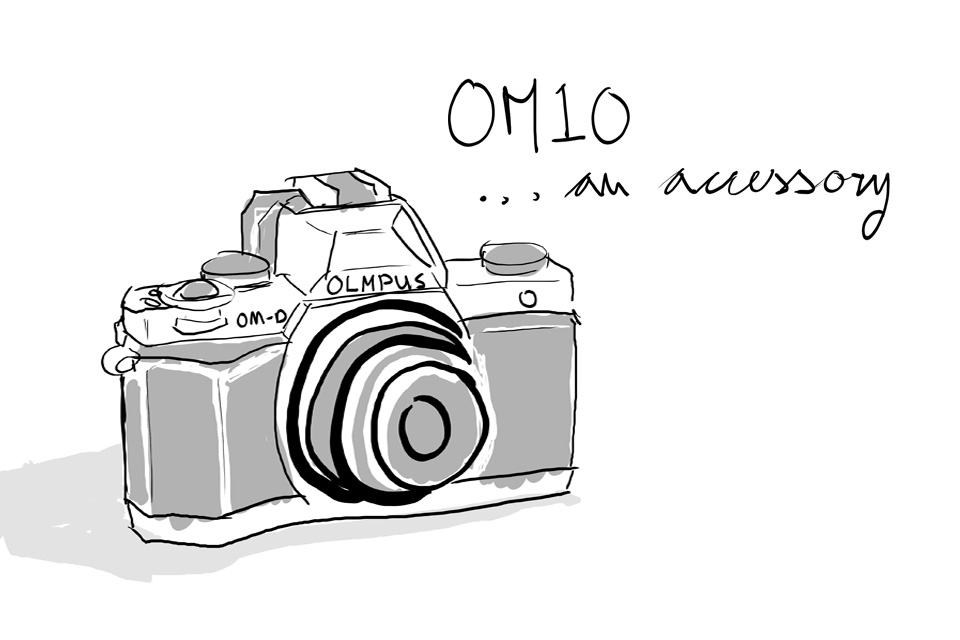
I had the pleasure to try out the new Olympus E-OM10 …a small and retro looking digital camera. This is a nice addition for the OM-D Series of Olympus because it’s small yet exchanges lenses and it has the looks. So when you take this camera with you it’s more like having a nice retro accessory instead of a bulky camera.
look at how small it really is
On the street I received several compliments about the look of the OM10. It’s easy to fit in my bag and lightweight so it could be your every day camera. Also the performance is nice when shooting steet style and street photography. The 14-42mm lens gives you the most practical view for both total body and portrait shots.
People keep surprising me, for instance these guys who’re demonstrating the fast burst rate of the awesome and way to expensive Canon 1D X. This body is like one of my dream cameras and they make sure that you won’t be able to use it anymore …in just 15 minutes! Why people? Why? Being scientific?